Foreign information manipulation and interference (FIMI) is a hybrid threat aimed at undermining democratic processes. It involves coordinated campaigns by foreign actors who use disinformation, propaganda and manipulation to shape public opinion and sow distrust.
In its latest report, published on 4 November 2025 (p. 97), the European Commission issued a warning to the country:
- Hybrid threats continue to pose a risk to North Macedonia, mainly through malicious foreign interference, the use of economic means to exert influence, the misuse of tools in the information space and cyber-attacks on ICT (information and communication technology) infrastructure. Further efforts are needed to limit the space for foreign information manipulation and interference (FIMI), including disinformation, and to strengthen society’s resilience to these and other forms of hybrid threats, the EC report states.
Foreign information manipulation and interference has long been a problem the country faces. The current EU Ambassador to the country, Michalis Rokas, also recalls such examples.
“We know from the past that important political milestones for the country, such as NATO membership and its overall pro-Western strategic orientation, have been targets of FIMI operations. The public may even remember cases in which foreign actors exploited local officials through pranks. These are not harmless episodes. They too are part of the broader FIMI pattern,” says Ambassador Rokas.
False bomb threats in Macedonia are also part of such campaigns. In 2022 and 2023, hundreds of schools received false threats that bombs had been planted. Besides interrupting classes and disrupting everyday life, these attacks had another goal – to create fear, panic and distrust in institutions. At the time, the authorities treated them as part of broader hybrid threats.
Rokas: Building resilience to FIMI must begin long before EU accession
But the foreign actors behind FIMI often have a much bigger goal, such as the reform process or EU accession. According to Ambassador Rokas, in the past period they have partly succeeded in their aims by slowing down the adoption of important legislative changes in the country.
“Any attempt at foreign information manipulation and interference (FIMI) aimed at negatively influencing the reform or electoral processes in the country can be interpreted as part of a broader anti-EU campaign that is already present. Certain findings indicate that this influence is mainly driven by domestic regressive groups linked to harmful foreign narratives and actors, who have long been trying to divert the country from its EU path. Unfortunately, they have recently managed to slow down the adoption of some key laws, especially in the area of human rights. At the same time, the reform process offers an opportunity to strengthen the institutional response. Through the Reform Agenda and broader EU support, the Government should establish a structured national response to FIMI – an area where further institutional development is still needed,” says Rokas.
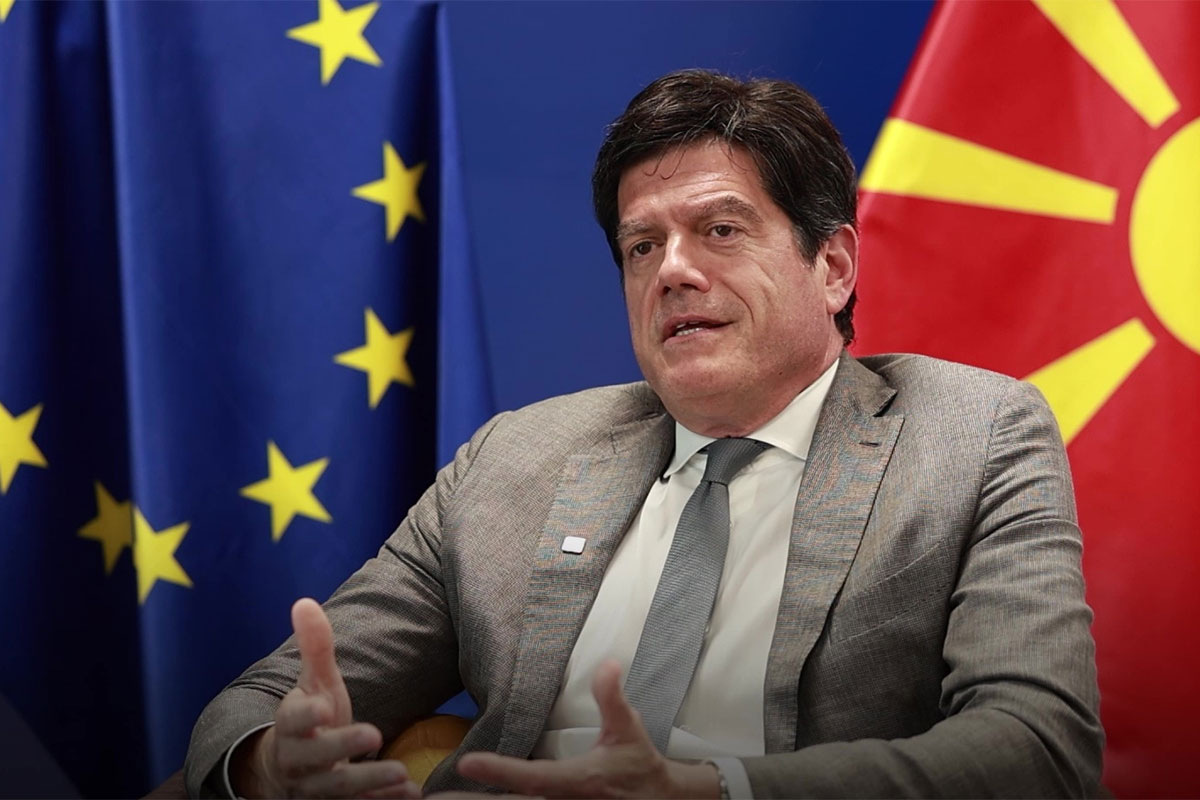
As Ambassador Rokas says, Macedonian institutions have begun cooperating to tackle these threats to the country’s development.
“There is already cooperation with the institutions on FIMI. For example, the EU is supporting the Ministry of Digital Transformation in aligning national legislation with EU law in the areas of digital transformation and media. This covers cybersecurity and capacity building for digital skills, the preparation of the Strategy and Action Plan for the development of the media sector, as well as aligning national legislation with the European Media Freedom Act, which also addresses FIMI-related issues. Last year we organised a media literacy conference in Skopje to support the debate in the region. We also provide capacity building for journalists, civil society organisations and the Agency for Audio and Audiovisual Media Services. Building resilience to FIMI must begin long before EU accession,” the EU Ambassador points out.
The FIMI problem in Macedonia was also included in the latest European Parliament report, adopted in June 2026 (point 24).
The European Parliament:
- expresses serious concern about persistent attempts to distort public debate and undermine trust in democratic institutions and the country’s European path through coordinated manipulation of the information environment, including covert influence operations and malicious narratives;
- calls on the EU and its Member States to step up efforts to support North Macedonia in countering malicious foreign interference in the country, including through technical assistance;
- underlines that malicious foreign influence weakens the credibility of institutions and polarises society;
- calls on the authorities to establish a comprehensive and institutionalised framework for democratic resilience with clearly defined responsibilities, regular risk assessments and public reporting, in line with evolving EU standards for the protection of democratic processes;
- further calls for advancing media and digital literacy, promoting fact-checking, combating hate speech in all its forms and strengthening resilience to hybrid threats that challenge democratic values and the country’s goal of EU membership.
“Numerous specialised and precise EU reports confirm the existence of this kind of foreign information manipulation and interference operations in North Macedonia. We welcome the growing awareness of FIMI among society, the media and institutions in North Macedonia. Public discussions on this issue are now much more present,” Rokas concludes.
The aim of FIMI is to divide us, to create fear, to reduce trust between citizens and institutions, and to influence the democratic development and progress of the country. The strongest defence is critical thinking. So be part of the change: check, think and share responsibly.
This content was produced by the Institute of Communication Studies
Journalist: Ivan Kuzmanovski
Camera: Ivan Popovikj
Editing: Risto Dushkovski
This article was translated from Macedonian using artificial intelligence (AI). The original Macedonian version is available here.