


Hundreds of foreign channels, but very little oversight: Who is shaping Macedonia’s TV landscape?
- Macedonia’s television landscape has long extended beyond its national borders — a single subscription package gives viewers access to hundreds of channels from the region and beyond.
- Foreign television programmes can influence cultural perceptions, language habits and the choice of news sources, as well as the way audiences interpret social and political events.
- This wide range of channels also raises questions about the potential for foreign information manipulation and interference, and the mechanisms for protection against such influences.
- We analysed the offer of the TV operators with the largest market shares to establish which foreign channels reach domestic audiences and whether appropriate procedures exist to protect against potentially negative influences.
What do the operators offer?
Makedonski Telekom, A1 Macedonia and Telekabel are the three operators with the largest shares in the distribution of TV content to end users on the Macedonian market. According to Agency for Electronic Communications data, there were a total of 443,780 TV service subscribers in the country at the end of last year, and these operators accounted for a combined 83.3 per cent of the market.
Makedonski Telekom has the largest overall offering if we consider the three operators together, in terms of the number of television services, followed by A1 Macedonia, with Telekabel in third place. Given the limited domestic offer, it is understandable that the operators’ television packages consist mainly of foreign television services. However, the large number of Serbian and Albanian channels is striking: at Makedonski Telekom, for example, their number exceeds that of English-language channels. Telekabel, on the other hand, is characterised by the predominance of Serbian channels and the absence of any foreign Albanian channels.
The combined packages of these operators also include TV channels from other countries in the region, such as Croatia, Bosnia and Herzegovina, Montenegro and Bulgaria, along with a few French and German TV channels. However, their number is negligible compared with the Albanian, Serbian and English-language channels.
These figures nevertheless need to be interpreted with care. They do not mean that the average viewer watches hundreds of foreign channels equally, and it must also be borne in mind that the offer varies according to the subscription package. Nor does every channel have the same influence on audiences. An operator may carry dozens of specialised sports, film or music services with very small audiences, while a single news or entertainment channel may attract a considerably larger audience. The number of available channels is therefore primarily an indicator of the structure of the media market and the potential for exposure, rather than a direct measure of influence. In any case, the structure of the offer matters.
The list of Makedonski Telekom, for example, includes numerous Serbian channels — Pink, RTS, Prva, Happy, KCN, B92, N1, Grand and IDJ — as well as many Albanian services from Albania and Kosovo, including RTSH, Klan, Tring, Top Channel, News 24, RTV21, RTK and a range of specialised channels.
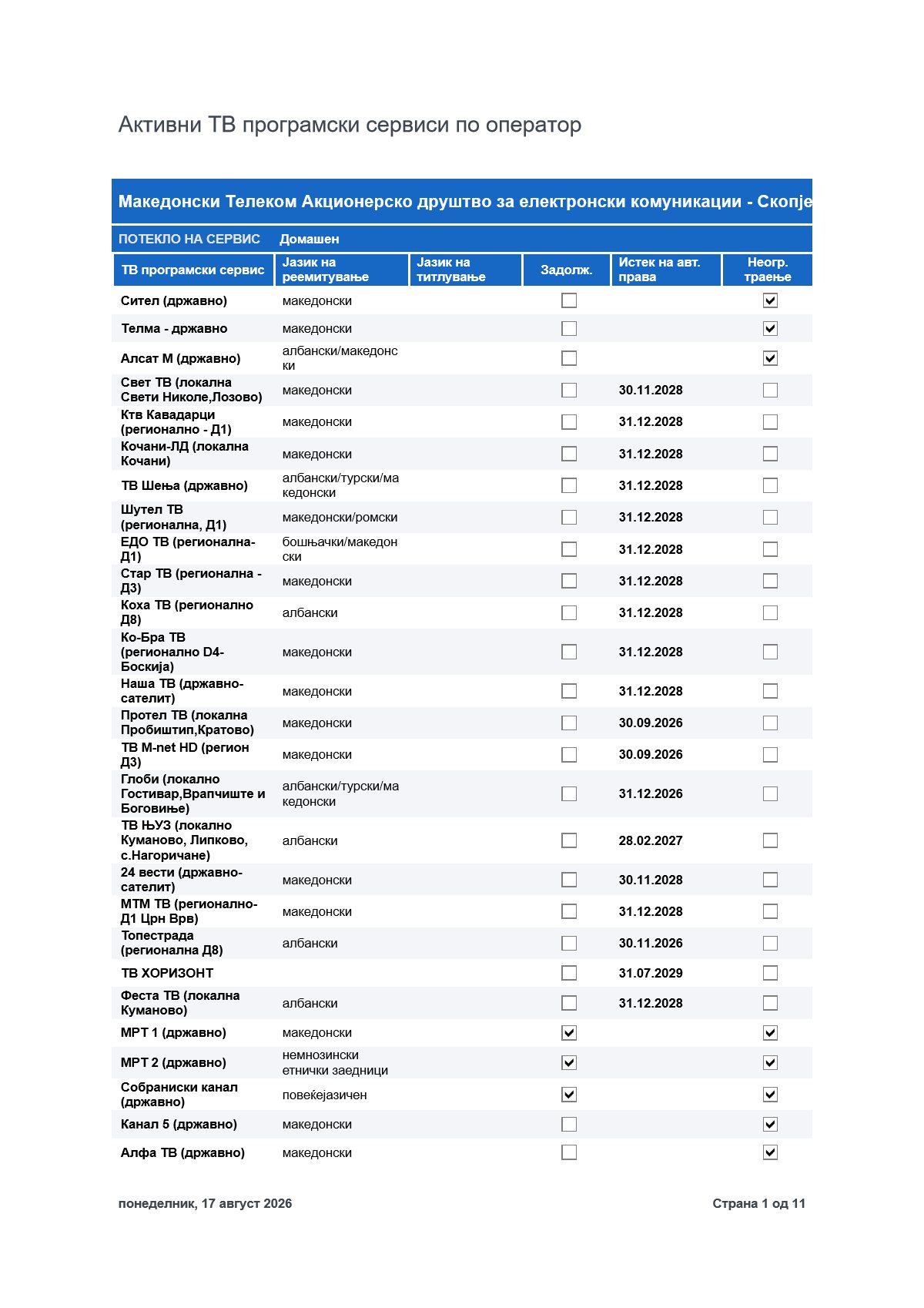
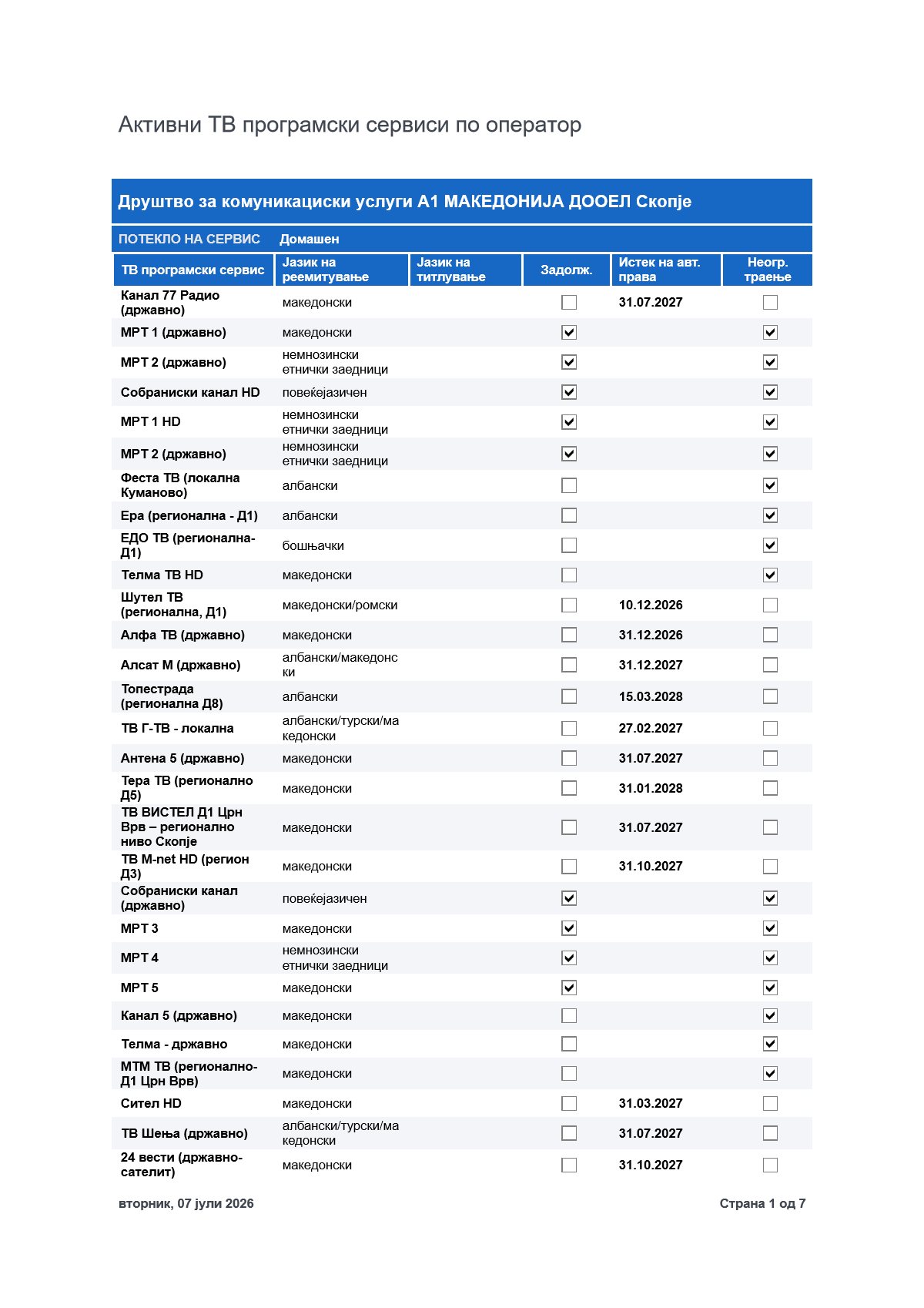
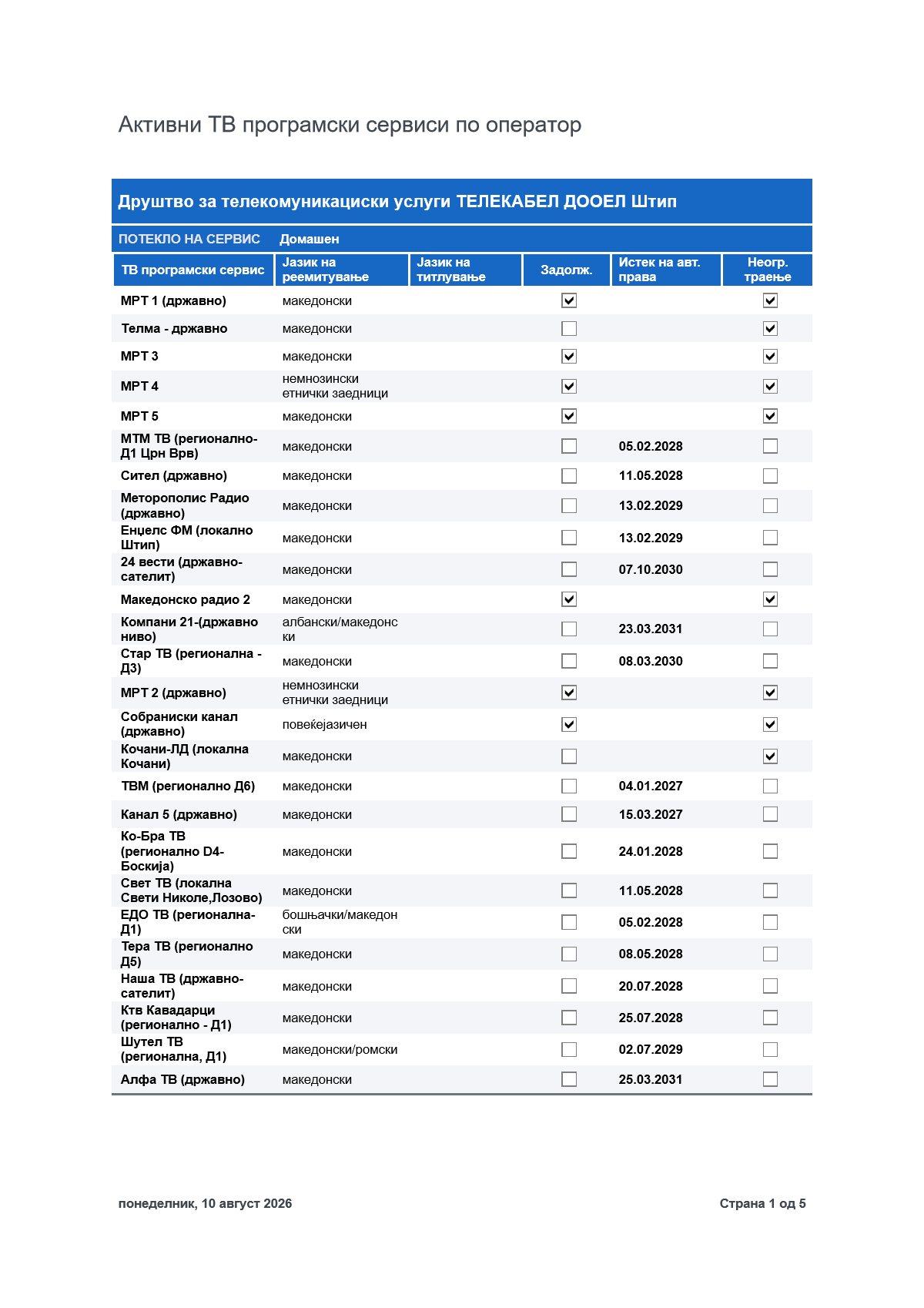
Combined programme service offerings of Makedonski Telekom, A1 Macedonia and Telekabel
A similar structure can be seen at A1 Macedonia. Its Serbian offering includes Prva, KCN, B92, Happy, Pink and other channels, while its Albanian offering includes TeVe, DigitAlb, News 24, RTSH, Klan Kosova, Dukagjini and others.
At Telekabel, Serbian channels have a particularly prominent presence: alongside RTS and B92, the offering includes Prva, Happy, N1, NOVA S, Grand and others.
Is linguistic proximity sufficient justification for this offering?
Linguistic proximity makes the regional television market different from the global market. English probably creates a barrier for some viewers, and in some cases content is translated or subtitled into Macedonian. Serbian, by contrast, is directly understandable to a large proportion of Macedonian viewers. The same applies to Albanian among the country’s Albanian audience.
Language preferences can clearly have a strong influence on audience choices, and in Macedonia this carries even greater weight because of the region’s linguistic and cultural ties. Media outlets from one country in the region can target audiences in another, while regulators have much less control over television services received via cable and satellite.
This need not necessarily be a problem. On the contrary, regional television can serve a positive purpose: viewers gain access to more information, cultural content, sport, films and entertainment programmes, while linguistic proximity enables them to follow content without translation. The problem begins when availability turns into the dominance of particular sources, especially in news and current affairs.
Television does more than transmit content — it frames it
A television channel is more than a technical signal. Every programme involves choices about topics, interviewees, photographs, words, context and how a particular event will be explained. The way the media present political and social issues can influence audience perceptions. The effects of journalistic “framing” are associated with changes in the content of people’s beliefs and the importance they attach to them.
In other words, two television channels can report on the same event, yet leave their audiences with different pictures of what happened, who is to blame, who is the victim and which solution is acceptable.
This is where the first significant risk for Macedonia emerges: if large numbers of people regularly follow news content from a neighbouring country, it matters what those channels broadcast, which topics they select and how they frame them.
The Serbian media landscape is particularly relevant to FIMI
This issue becomes more serious when placed in the context of foreign information manipulation and interference. This is a complex mechanism combining propaganda tactics, media manipulation, destabilisation through social networks, economic and political pressure, and even cyber activities. At its core is the deliberate distortion of the information landscape to achieve long-term geopolitical influence. Several studies show that some Serbian media outlets are used as sources for spreading pro-Russian messages in Macedonia, precisely because a substantial proportion of the population understands Serbian.
This means that content does not have to reach Macedonian viewers directly from Moscow. It may be published by a Russian state media outlet, then relayed through a Serbian-language outlet, picked up by a Macedonian news website or television channel, and eventually appear on social networks. In this process, the original source may become less visible while the message continues to circulate. This is one of the reasons why linguistic proximity is relevant to foreign information manipulation and interference (FIMI). It reduces distribution costs and increases the likelihood that content will be understood, picked up and republished.
This does not mean that all Serbian television channels constitute FIMI. That would be an incorrect conclusion. The risk arises when a media channel becomes part of the infrastructure through which a particular manipulative narrative can easily reach audiences, be accepted as a familiar and relatable source, and then continue to circulate through the domestic information space.
What about Albanian channels?
We have already noted the large number of Albanian channels from Albania and Kosovo in the offerings of Makedonski Telekom and A1 Macedonia. Alongside entertainment and music services, several news channels are also available.
Here, however, it is important to avoid a simplistic, symmetrical interpretation in which “Serbian” and “Albanian” automatically signify two foreign propaganda blocs. Albanian media in Macedonia form part of the Albanian community’s wider media and linguistic space, and their presence also serves a legitimate cultural and linguistic purpose.
Nevertheless, from the perspective of media pluralism and FIMI, it is important to ask the same questions as for Serbian media: how many of the news sources followed by Albanian audiences are domestic and how many are external, which countries produce that information, what political and geopolitical frames do they use, and is their content subsequently relayed into Macedonia’s information space?
European concerns about Serbia and Albania
Given the clearly significant presence of Serbian and Albanian media in Macedonia through TV operators’ offerings, the state of the media in those countries must also be considered.
In one of its latest reports on Serbia this year, the European Commission expressed concerns about the editorial independence and pluralism of public service broadcasters.
“Against a backdrop of further concentration in the media market, political and economic influence over the media remains a serious problem. Media legislation and the media strategy are not being implemented adequately, particularly regarding the fairness of public funding and the transparency of ownership structures. Journalists frequently face refusals by public institutions to provide information, or receive no response at all. Journalists’ safety has deteriorated further, with an increase in physical attacks and threats,” the report states.
The European Commission warned of similar problems in Albania, noting concerns about the independence of the media regulatory body arising from the procedure for nominating board members and their political affiliations.
“The limited independence of the public service broadcaster is also a concern. Although steps have been taken to address transparency of media ownership, media concentration and market penetration by business groups with political connections remain serious concerns. Although some steps have been taken towards establishing an audience measurement system, the fair distribution of state advertising and other state resources has yet to be ensured. Shortcomings persist regarding the right of access to information. Cases of verbal and physical threats, smear campaigns and strategic lawsuits against public participation (SLAPPs) targeting journalists continued,” the European Commission document states.
Cultural influence is a cause for concern
The potential influence of foreign television is not confined to news and politics. Television can influence language, habits, perceptions of success, family, gender roles and views of other countries. The messages conveyed by turbo-folk music, low-quality, cheaply produced television series and reality shows can distort domestic audiences’ perceptions of what constitutes a normal life and a good quality of life. Television content can thus become part of how audiences understand the world and other societies, even when it does not involve political propaganda.
Is there adequate oversight?
We sent questions regarding this issue to the Agency for Electronic Communications (AEC) and the Agency for Audio and Audiovisual Media Services (AVMU) to establish whether, and how, the programmes offered by TV operators are subject to oversight.
The AEC replied that it could not provide a substantive answer because its powers are prescribed by the Law on Electronic Communications, under which it has no authority to regulate the content of programme channels broadcast or retransmitted by an operator of public electronic communications networks.
“Under the law, this responsibility is entrusted to another institution, in this case the Agency for Audio and Audiovisual Media Services (AVMU). Under the Law on Audio and Audiovisual Media Services, AVMU is responsible for registering programme packages,” the AEC stated.
AVMU explained that the procedure for registering programme services and the conditions for their re-broadcasting through operators of public electronic communications networks are governed by the Law on Audio and Audiovisual Media Services, specifically Articles 44, 141 and 143.
“Article 44 of the Law guarantees freedom of reception and re-broadcasting of audio and audiovisual media services from EU Member States and other European countries that are signatories to the European Convention on Transfrontier Television. Article 143(2) provides for the re-broadcasting of foreign programme services in North Macedonia in accordance with Article 44 and on the basis of an agreement governing copyright and related rights. Under Article 141, before re-broadcasting begins, the operator submits an application to AVMU for entry in the register and registration of the programme services as a package,” AVMU stated.
The Agency explained that the application contains details of the operator and the responsible person, the list of services, the method and area of re-broadcasting, the starting date and other information. Operators must also submit, with the application, a statement by the responsible person, under full criminal and financial liability, confirming that copyright and related rights have been cleared, together with notarised copies of the re-broadcasting agreements.
Asked whether, when issuing the certificate, AVMU examines the content of the programme service or whether the checks are primarily formal — registration, copyright and compliance with statutory requirements — the Agency said that issuing the certificate is a purely formal legal procedure. It establishes whether the statutory requirements have been met and whether documentation exists to support the right of re-broadcasting; it does not examine the content broadcast by the programme service that the operator wishes to retransmit.
The Agency pointed out that the Law does not vest AVMU with general discretionary powers to refuse registration on the basis of an unspecified assessment that a foreign channel is undesirable or poses a risk to the information space.
“As we noted earlier, Article 44 guarantees freedom of reception and re-broadcasting of programme services from EU Member States and other European states that are signatories to the European Convention on Transfrontier Television,” AVMU said.
Nevertheless, the Agency added, the legislature has provided for restrictions on reception and re-broadcasting. Article 45 allows temporary restrictions under specific conditions: manifested, serious and grave breaches of the prohibitions on public incitement to terrorism, violence or hatred, or of the rules on the protection of minors, as well as threats or a serious and grave risk to public health or public security, including national security and defence. Application depends on the jurisdiction over the service and compliance with the statutory procedure, including notification, cooperation with the competent foreign regulator and the role of the European Commission in the cases provided for by law. Measures must be based on specific facts, be proportionate and respect the right of defence. General concepts such as “public interest” and “media pluralism” do not, in themselves, replace the necessary legal basis.
“In addition, a ban on re-broadcasting may arise from government decisions adopted under the Law on Restrictive Measures. This mechanism was applied in 2022 to certain Russian programme services, including RT – Russia Today and Sputnik. At the time, AVMU notified operators of their obligation to implement the government decisions and cease retransmitting the services concerned,” AVMU explained.
Asked whether regulatory oversight takes into account the composition of the offering — specifically, whether there is an excessive concentration of programme services from one country or media space — AVMU said it records the list of programme services in each operator’s package and checks whether the retransmitted offering complies with its registration and statutory obligations.
“The Law does not set quotas or a maximum permitted share of channels from any particular foreign country or media space. Their number alone is therefore not a criterion for refusing registration or excluding them from a package. The statutory rules on prohibited media concentration concern the ownership, links and control of media entities, and apply only to domestic broadcasters broadcasting in Macedonia,” the Agency said.
On whether AVMU regularly monitors foreign channels retransmitted by Macedonian operators or carries out checks only in response to complaints and identified infringements, the Agency said that it conducts regular, extraordinary and follow-up programming inspections of operators.
“For this purpose, the Agency adopts an Annual Programming Supervision Plan providing for regular inspections of their programme packages twice a year, once in each half of the year. These cover the registration of re-broadcasted services, compliance with subtitling rules and the mandatory provision of public service broadcasting services free of charge. Extraordinary inspections may be conducted on the Agency’s own initiative or at the request of government bodies, legal entities or individuals, while follow-up inspections check operators’ compliance with public warnings issued against them. Oversight therefore does not depend solely on submitted complaints,” the Agency pointed out.
Asked whether AVMU’s regulatory methodology recognises foreign information manipulation and interference (FIMI) as a potential risk in the television landscape, the Agency said it has no direct powers in this area, but that its representatives participate in various activities and initiatives organised by government bodies or non-governmental organisations.
How is the TV offering shaped?
We also asked the three largest TV operators how they choose which foreign television channels to offer on the Macedonian market, in order to investigate whether there are procedures or analyses addressing the potential influence on the language, culture or values of domestic audiences, as well as the risks of foreign information manipulation and interference (FIMI).
By the time of publication, only Makedonski Telekom had replied; A1 Macedonia and Telekabel had not responded.
Asked which criteria determine which foreign television channels are included in the offering — audience ratings, licence fees, customer interest, regional popularity or other factors — Makedonski Telekom said that, since launching its service, the company has continuously analysed the market and monitored customer trends, habits and needs.
“We are guided primarily by our customers’ interests and requests, as well as the availability of channels/content on the market. We also consider their popularity and relevance to local audiences, programme content, quality and the terms on which channels are available. In this way, we seek to continually adapt the offering to customer interests and current market conditions,” Makedonski Telekom said.
When selecting regional channels, do you consider their production content and potential influence on the language, culture or values of domestic audiences, or is the choice guided primarily by commercial criteria?
“Their programming and production content is, of course, also considered, along with its relevance to domestic audiences. Selection is not based solely on commercial criteria: care is taken to ensure that, in addition to meeting audience interests, the content included in the offering is appropriate and complies with the applicable regulations. In this respect, the regulatory framework clearly sets out the conditions under which audiovisual content may be broadcast, including the requirement that it must not contravene Macedonia’s Constitution, laws or constitutional order. When shaping the offering, we therefore consider the broader social context alongside customer interests and other market criteria,” Makedonski Telekom said.
How important is the price of content when deciding whether to include a particular foreign channel in a package? Does cheaper regional production create an economic incentive to offer more such content?
“The price of the content is one of the factors considered when shaping the offering, but it is neither the only nor the decisive criterion. Unfortunately, given the limited domestic production and the daily closure of domestic national, regional and local TV channels, we are compelled to allocate a greater share of our offering to regional and foreign channels and productions. Decisions to include a particular channel also take account of customer interest, competitors’ offerings, the appeal and relevance of the content, and the overall value of the offering. This is precisely why regional channels are largely offered through additional programme packages, which customers can choose for themselves, activate separately and pay for according to their interests. This allows customers interested in such content to select it without it being part of the basic tariff packages. In higher-tier tariff packages, on the other hand, some regional packages are included in the tariff itself. In this way, we seek to strike a balance between the variety and appeal of the offering, customer interests and the economic viability of Makedonski Telekom’s TV offering,” the company stated.
When selecting and including foreign news and documentary channels, do you analyse their ownership structure, editorial policy or possible risks associated with foreign information manipulation and interference (FIMI), particularly in the case of state-funded or international media services?
“When selecting and including foreign news and documentary channels, we apply internal procedures to every prospective partner. These procedures cover a number of relevant aspects, including some of the elements mentioned in the question, as well as other relevant factors and potential risks. These procedures are applied consistently when selecting every partner, so that decisions to include channels are based on clear, predetermined criteria. Alongside commercial and customer considerations, this also takes account of the broader regulatory and content-related aspects relevant to the offering,” Makedonski Telekom pointed out.
Greater awareness is needed
The Agency for Audio and Audiovisual Media Services recently conducted a survey of a representative sample of respondents, which found that as many as 86 per cent connect their main television set through a cable operator, while the proportion using their own digital or satellite antenna is considerably lower (around 10 per cent in total).
To keep up with current events, most respondents use social networks (62.3 per cent) and television (61.2 per cent) daily. Television is perceived as the most objective medium, with a total of 56.2 per cent of respondents considering it completely or mostly objective. It is also the medium respondents trust most (37 per cent), more than twice the figure for news websites (14.8 per cent) and social networks (7.8 per cent). The largest share of respondents (34.3 per cent) watch between half an hour and two hours of television a day. Almost one in four people (24 per cent) spends more than four hours in front of the screen, while only a negligible 0.3 per cent said they do not watch television at all, confirming the medium’s broad reach. News is the most popular choice, with 31 per cent of respondents identifying it as the content they watch most often.
A significant proportion of audiences in Macedonia are exposed to foreign offerings from linguistically close media spaces, primarily Serbian and Albanian, which are sufficiently understandable to a substantial share of domestic viewers that no translation is needed. This makes it clear that a distinctive media space has developed here, in which information can cross borders with very little resistance: from a television channel in Serbia or Albania to a Macedonian news website, and from there to Facebook or another social network. For FIMI, this circulation matters more than the origin of the channel itself. Foreign operations increasingly use networks of different channels, republication, content adaptation and mutual amplification.
This means that a television operator may have no intention whatsoever of spreading foreign influence. Its task is to offer customers an attractive package. However, if the channel itself forms part of a wider network producing and distributing manipulative narratives, it can become one of the points through which that content reaches domestic audiences.
The question for Macedonia is therefore not whether foreign channels should be available, but how to establish appropriate oversight and procedures concerning which foreign channels are offered, what they broadcast, where they obtain their information, which narratives they use and what happens to their content once it reaches Macedonian audiences.
This content was produced by the Institute of Communication Studies.
Photographs: magnific.com and envato.com
- Објавено:
- Views: 170
Тагови:
