


Fake videos, real risks: How can elections be protected from AI misuse?
- Artificial intelligence will make it much easier to influence voters and make the messages far more convincing, while making their source even harder to trace
- Foreign influence operations typically exploit existing problems and divisions to instigate apathy, fear, interethnic tensions or distrust in institutions and the electoral system
- False content is particularly dangerous when it appears just before voting, leaving little time to verify or debunk it.
- During elections in Germany, the US and other European countries, investigators uncovered operations using AI to impersonate international news outlets and spread false content promoting pro-Russian narratives. The best-known operation is ‘Doppelgänger’
Artificial intelligence is increasingly used to produce political content, from virtual presenters delivering political messages to illustrations and short videos targeting political opponents. It is also playing a growing role in how voters learn about politics and elections. This has raised concerns that these tools could be used for malign foreign influence and information manipulation during elections.
From chatbots to online searches, people encounter AI-generated content, sometimes without realising it. Some use AI as a tool for finding information, while others see it as an authoritative source of advice.
These changes present new challenges for campaign teams and the authorities. Political parties need to rethink their digital strategies. The State Election Commission and other bodies need to review how they protect data, inform voters and safeguard trust in the electoral process.
Foreign influence operations around the world
Artificial intelligence can help improve democratic processes, but its misuse for manipulation and disinformation poses risks, especially during elections.
In the run-up to the 2025 parliamentary election in Germany, fabricated content targeting Friedrich Merz, then a candidate for chancellor, circulated online. In one video, a person posing as a psychiatrist falsely claimed to have treated Merz after a mental health crisis in 2017. BBC Monitoring documented how the claim spread through websites linked to the Storm-1516 operation.
In another case, false testimony circulated about Robert Habeck of the Greens, alleging a corruption scandal over the sale of Picasso paintings to Ukrainian billionaires. Researchers at Project Gnida link these cases to the Russian disinformation operation Storm-1516, which spreads content through a network of websites and social media accounts.
Another operation, Doppelgänger, is known for imitating the websites of reputable news outlets. These lookalike sites and fabricated stories spread pro-Russian narratives and discredit Western policies, particularly support for Ukraine. In September 2024, the US authorities took action against actors linked to the operation as part of efforts to prevent foreign influence on elections.
During the 2024 US presidential campaign, intelligence agencies warned that Russia and Iran were using generative AI to amplify their influence operations. The content they identified included manipulated speeches by Kamala Harris.
Ahead of the US congressional elections scheduled for 3 November 2026, researchers have also warned of a new campaign by Matryoshka, a network linked to Russia.
According to MS NOW, researchers at Antibot4Navalny identified 16 videos featuring manipulated footage of public figures and content made to look like CNN reporting. The videos spread baseless allegations against Democrats and urge viewers to vote against their candidates. An analysis by the Brennan Center also describes the circulation of synthetic videos featuring public figures and fake reports passed off as CNN content.
Reports from technology companies show that AI is becoming a routine part of these operations. According to the Brennan Center’s analysis of their findings, Meta identified the use of generative AI in every network engaged in coordinated inauthentic behaviour covered by the report, from generating profile pictures to automating content production.
Anthropic also reports operations that use AI to create fake profiles and websites posing as news outlets while concealing who is behind them.
What is true and what is false?
Foreign influence can involve spreading propaganda as part of a wider attempt to destabilise a country or community.
How easy is it to misuse AI to create fake news and deepfake videos and manipulate the public? How difficult is it to tell whether such content comes from someone inside the country or from a foreign influence operation?
‘The way people exert influence will stay the same. AI will make it much easier to do and the results much more convincing. We may be unable to trace the source at all,’ says Professor Dimitar Trajanov of the Faculty of Computer Science and Engineering (FINKI).
He says the danger lies in being able to produce far more content at a much higher quality than before.
Communications expert Sead Dzigal warns that the consequences could be wider.
‘The greatest danger goes beyond people believing false content. Its very existence can make them doubt everything they see or hear in the media,’ says Dzigal.
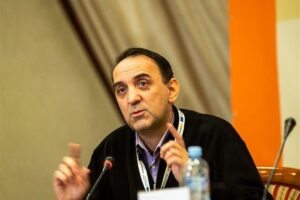
Read the full interview with communications expert Sead Dzigal
Artificial intelligence makes it possible to produce convincing false content quickly and to tailor propaganda to different audiences. Dzigal explains how this affects elections and how to respond to a fake video.
What do the cases in Macedonia so far show?
Analyses of the 2024 presidential and parliamentary elections and the 2025 local elections give only a partial picture of how widely AI was used in political communication. Questions remain about how often it was used to impersonate people or organisations, discredit politicians or steer public debate through manipulation, and who was behind individual posts.
A report by International IDEA, prepared in cooperation with Metamorphosis and published in 2025, states that the impact of AI-generated content in the country had been limited up to 2024.
One documented example that appeared on social media after the presidential election was a video in which President Gordana Siljanovska-Davkova appeared to offer greetings for ‘2 August, Mitrovden’. In a fact-check published on 4 August 2025, Vistinomer found that the video had been generated with AI and that the president had never made the statement. The fact-check pointed to discrepancies in her voice, appearance and facial expressions as signs of manipulation.
The Institute of Communication Studies (ICS) asked the four largest parties, VMRO-DPMNE, VLEN, SDSM and DUI, whether they use AI in political communication, whether they are concerned about foreign influence in the next elections and how they plan to protect themselves. None of the parties responded.
The presence of false content alone leaves open whether it is an isolated case or part of an organised campaign.
Advances in technology are making false content harder to detect. Trajanov explains that content made with cheaper platforms is easier to spot, while sophisticated tools can produce much more convincing videos. If the creator has enough expertise and money, viewers may find it extremely difficult to distinguish generated footage from an authentic recording.
Professor Trajanov also points out that AI can be used to check and detect suspicious content.
‘If you put a news story into ChatGPT and ask it to check whether it is true or false, it will give you some information. The question is how many people will actually do that,’ says Trajanov.
Manipulating attention, emotions and trust
False content is particularly dangerous when it appears just before voting, leaving little time to verify or debunk it.
‘In the fast-moving world of digital communication, the first piece of information has far more impact than later responses or corrections. AI also makes it possible to personalise propaganda by targeting different groups of voters with different messages. That makes the messages more effective at manipulating people and causing harm. The harm goes beyond the spread of false information. It also comes from manipulating people’s attention, emotions and trust,’ says Dzigal.
Artificial intelligence threatens free elections when it is used to mislead voters and disrupt the electoral process.
What does this look like?
Fake media outlets and fake posts
- Deepfakes: Artificial intelligence can create highly realistic fake videos and audio recordings of political leaders.
- False statements: These fake recordings can make candidates appear to say things they never said.
- Misleading voters: False content can mislead the public and damage the reputation of the candidate.
Cyberattacks
- Finding security vulnerabilities: Artificial intelligence helps hackers scan the computer networks of the election authorities and find security flaws much faster.
- Sophisticated phishing: AI can generate highly convincing fake emails designed to steal passwords and data from election officials.
- Disrupting systems: These attacks can slow down or disrupt routine election operations.
Malign foreign influence can aim to sway voters towards a particular candidate. It can also be used to fuel apathy, fear, interethnic tensions or distrust in institutions and the electoral system.
‘Foreign influence operations rarely invent entirely new issues. They are much more effective when they find existing problems and divisions in society and amplify them. In Macedonia, this could mean interethnic relations, identity and language, relations with neighbours, the EU and NATO, migration, corruption or economic insecurity,’ Dzigal explains.
He also warns that the situation can escalate. When manipulative content touches on a sensitive issue and stirs fear, anger or a sense of injustice, it can contribute to verbal confrontations, protests or even incidents. That is why, he says, foreign influence should also be seen as an attempt to destabilise a country or community.
Security protocols and possible legislative changes
AI misuse can also target information about the voting process itself. Beyond trying to influence whom people vote for, manipulative content can confuse voters by giving them false information about polling stations, required documents or how to cast their vote.
Bojan Marichikj, president of the State Election Commission, says that several institutions and teams of IT experts assigned to the elections are involved in implementing security measures.
He says the Commission has adopted a communications strategy covering secure communication, the processing and publication of election results, and its day-to-day operations.
‘We also have a procedure that sets out a dedicated communications protocol during elections and a separate protocol for operations and communications during incidents, emergencies or disasters,’ says Marichikj.
However, in its assessment of the 2025 local elections, ODIHR points to limited resources and outdated infrastructure that affected some of the work of the election administration. The Commission president acknowledges that institutions are still unaware of some threats and that gaps in the rules remain.
Marichikj believes that, when considering the new Electoral Code, lawmakers could look at regulating the use of AI in elections. He stresses that any such measures should be ‘balanced against freedom of expression and the freedom to compete in elections’.
The only protection for citizens is media literacy and trust in professional media and institutions.
AI can help organise elections, process information and communicate with citizens. Its use requires human oversight and clear accountability. It should serve as a tool, with people retaining responsibility for decisions.
This content was produced by the Institute of Communication Studies.
Reporter: Sanja Vasić
Video editing: Risto Dushkovski
Photographs: envato.com, sec.mk and ChatGPT
- Објавено:
- Views: 92
